
Why Digital Marketing Outshines Offline Marketing in 2025
In a world where screens dominate our attention and data drives decisions, marketing strategies are evolving faster than ever. While traditional offline marketing still has its place, digital marketing is increasingly the smarter, more effective choice for most businesses today.
If you’re deciding where to focus your marketing efforts, here’s why digital marketing takes the lead in 2025.
What is Offline (Traditional) Marketing?

Offline marketing includes strategies that don’t rely on the internet:
- Newspaper, radio, and TV ads
- Flyers, brochures, and billboards
- Events, sponsorships, and word-of-mouth
It still works well for hyper-local promotions and reaching audiences who may be less digitally connected.
But here’s the catch: offline marketing is often expensive, hard to measure, and limited in targeting.
What is Digital Marketing?
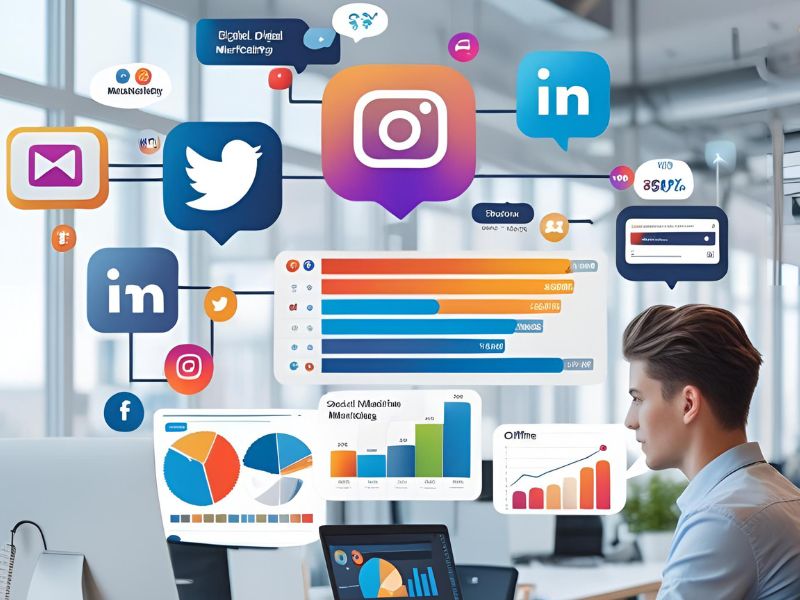
Digital marketing uses online channels like:
- Social media (Facebook, Instagram, LinkedIn)
- Google Ads & SEO
- Email campaigns
- Content marketing (blogs, videos, infographics)
- Influencer partnerships
What sets it apart? Precision, flexibility, and data.
Why Digital Marketing is More Preferable in 2025

✅ 1. Better Targeting
Digital platforms allow you to target users based on:
- Location
- Interests
- Age, gender, behavior
- Device usage and even time of day
Traditional marketing? You’re paying to reach everyone—including those who aren’t your ideal customer.
✅ 2. Cost-Effective for All Business Sizes
You can launch digital campaigns for a fraction of the cost of a newspaper ad or TV spot.
Plus, you can scale your budget up or down based on performance.
✅ 3. Real-Time Performance Tracking
With tools like Google Analytics and Facebook Ads Manager, you’ll know:
- Who clicked
- Who converted
- What’s working—and what’s not
Offline marketing offers little to no immediate feedback.
✅ 4. Faster, Easier Updates
Need to change your ad or offer?
Update your campaign instantly.
Traditional media requires days—or weeks—to revise and republish.
✅ 5. Two-Way Engagement
Digital platforms let customers interact, comment, and share, creating deeper brand relationships.
Offline methods are usually one-way communication—you talk, the audience listens (or ignores).
✅ 6. Global Reach, Local Impact
Whether you’re a small business or a growing brand, digital marketing lets you:
- Reach global markets
- Target local neighborhoods
- Do both—without doubling your budget
Side-by-Side Comparison
| Feature | Digital Marketing | Offline Marketing |
|---|---|---|
| Targeting | Highly specific | Broad, general audience |
| Cost | Low & scalable | High upfront costs |
| Speed | Instant launch & edits | Slower execution |
| Tracking | Real-time analytics | Minimal measurement |
| Engagement | Two-way, interactive | One-way communication |
| Flexibility | Easily adjustable | Static once published |
When is Offline Marketing Still Useful?
Offline strategies can still work well for:
- Local events and sponsorships
- Building brand credibility in older or offline audiences
- Physical product sampling (e.g., food tastings, brochures)
But even in these cases, a digital layer enhances results—think QR codes, social media hashtags, or live-streaming events.
Final Thoughts: Go Digital to Grow
In 2025, the world is online—and your marketing should be too.
While traditional marketing may still have a role, digital marketing is faster, smarter, more measurable, and more adaptable to changing business needs.
🚀 Want to grow your business with digital marketing? Let’s talk strategy
Very Valuable Knowledge!
Thank you for this knowledge!
This was very helpful for me!